Journal article published in Food Chemistry, volume 529, pp. 151142.
Authors: .
Abstract
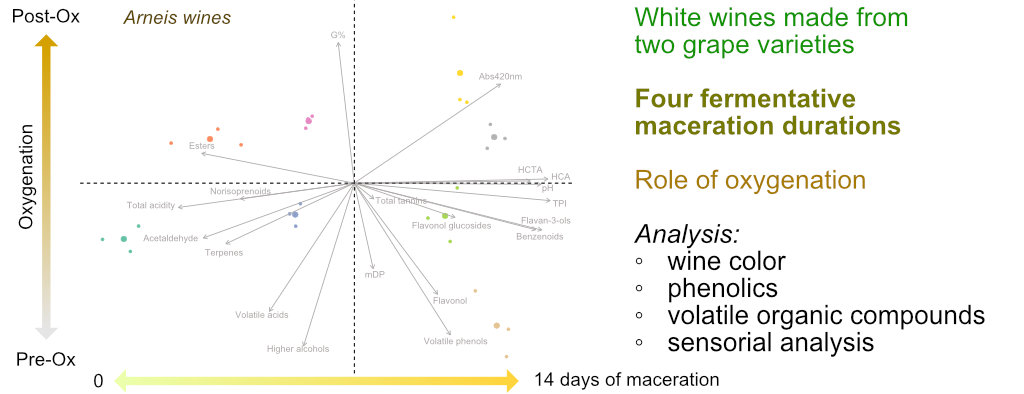
Fermentative skin contact is increasingly applied in white winemaking, yet its compositional and sensory consequences remain underexplored. This study evaluated Arneis and Erbaluce wines produced under four maceration regimes (0, 2, 7, and 14 days), as well as the effect of post-fermentative oxygenation for each wine obtained. Phenolic composition was quantified by LC-MS/MS and spectrophotometry, volatile compounds by GC-MS, and sensory attributes through a trained panel using a Rate-All-That-Apply (RATA) approach. Extended maceration substantially increased proanthocyanidins, flavan-3-ols, hydroxycinnamates, and flavonols, reaching levels comparable to red wines, while color shifted toward deeper yellow hues. Oxygenation reduced monomeric flavanols and esters and amplified oxidative notes. Sensory evaluation revealed heightened astringency and dryness in long-macerated samples, alongside diminished fruity aromas. These findings demonstrate that fermentative maceration strongly modulates the phenolic and aroma profiles of white wines, with oxygen exposure further refining their sensory expression.
Key words maceration, oxidation, phenolic compounds, volatile compounds, aroma profile, mass spectrometry, white wines
BibTeX entry: click to show
@article{
	2318_2160550,
	url = {https://hdl.handle.net/2318/2160550},
	author = {Ferrero, Lorenzo and Lagori, Marco and Kasianova, Anastasiia and Boido, Micaela and Botta, Giorgia and Cordero, Beatrice and Paissoni, Maria Alessandra and Río Segade, Susana and Rolle, Luca and Giacosa, Simone},
	title = {Exploring fermentative skin contact effects and post-fermentative oxidation on phenolics, aroma, and sensory characteristics in white wine},
	year = {2026},
	journal = {Food Chemistry},
	volume = {529},
	abstract = {Fermentative skin contact is increasingly applied in white winemaking, yet its compositional and sensory consequences remain underexplored. This study evaluated Arneis and Erbaluce wines produced under four maceration regimes (0, 2, 7, and 14 days), as well as the effect of post-fermentative oxygenation for each wine obtained. Phenolic composition was quantified by LC-MS/MS and spectrophotometry, volatile compounds by GC-MS, and sensory attributes through a trained panel using a Rate-All-That-Apply (RATA) approach. Extended maceration substantially increased proanthocyanidins, flavan-3-ols, hydroxycinnamates, and flavonols, reaching levels comparable to red wines, while color shifted toward deeper yellow hues. Oxygenation reduced monomeric flavanols and esters and amplified oxidative notes. Sensory evaluation revealed heightened astringency and dryness in long-macerated samples, alongside diminished fruity aromas. These findings demonstrate that fermentative maceration strongly modulates the phenolic and aroma profiles of white wines, with oxygen exposure further refining their sensory expression.},
	keywords = {maceration, oxidation, phenolic compounds, volatile compounds, aroma profile, mass spectrometry, white wines},
	doi = {10.1016/j.foodchem.2026.151142},
	pages = {151142}
}
Publication availability
Open access
This file is available in a open access version. It is possible to download this file and distribute it observing the limitations indicated in the license.
Supplementary material (from IRIS): File 1
View or request this publication
You can find the postprint version of this article in the Open Access Repository of the University of Torino:
IRIS-AperTO record 2318/2160550
View the final version at publisher:
doi:10.1016/j.foodchem.2026.151142
File not available? Do you need further information?
You can contact me and request this article through the following form: