Journal article published in PLOS One, volume 21, pp. e0345134.
Authors: .
Abstract
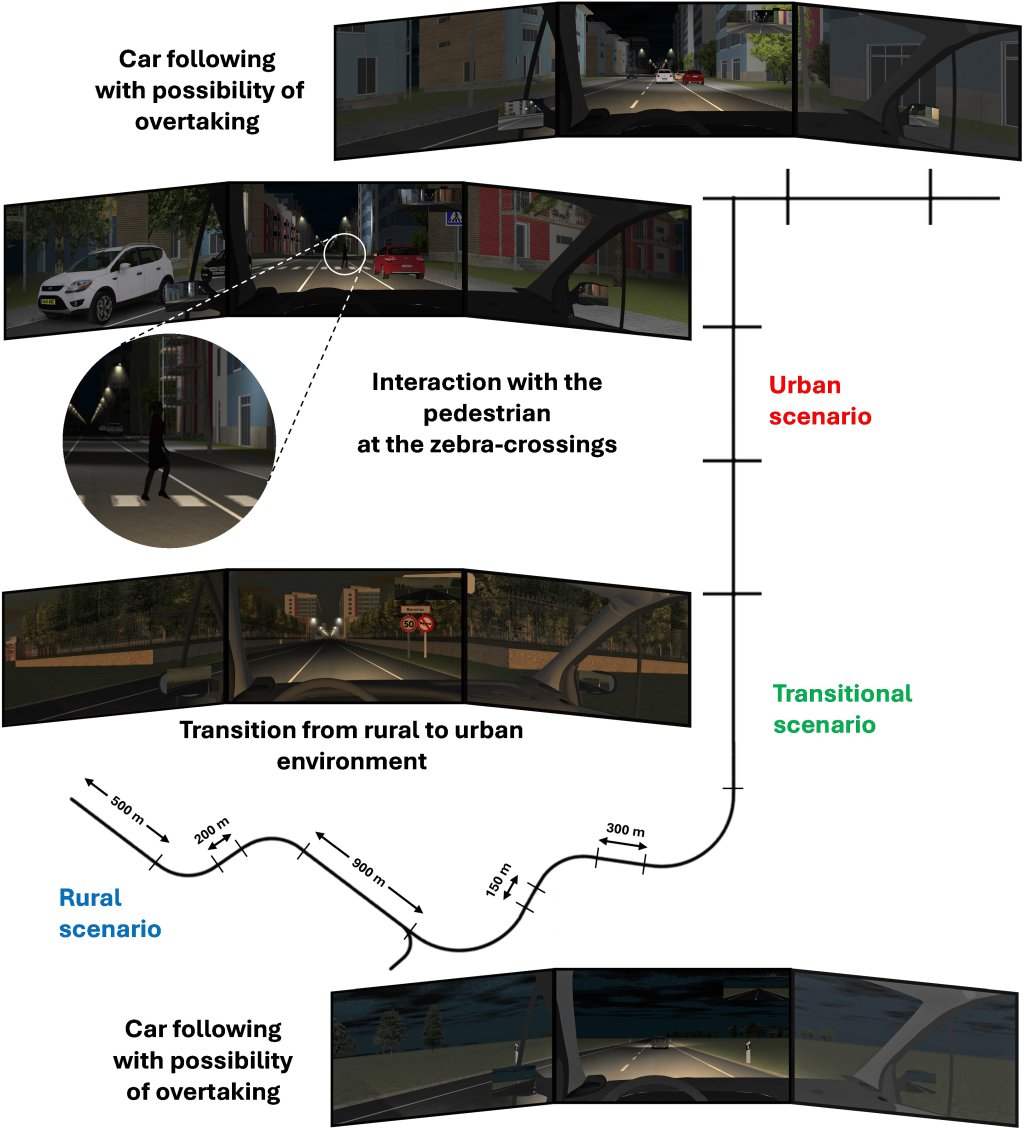
Background Alcohol consumption is a contributing factor to traffic crashes and road fatalities worldwide. While the effects of blood alcohol concentration (BAC) on driving performance are well documented, less is known about the role of sulphites, used for their antimicrobial and antioxidant properties, on driving performance. Method Using a triple-blind, randomised, within-subjects design, thirty-two participants completed three driving simulation trials under sober conditions and after consuming a conventional red wine with ‘low’ (86 mg/l) and ‘high’ (126 mg/l) sulphite content, while maintaining a BAC at about the Italian legal limit (0.5‰). The driving behaviour was assessed in rural, urban and rural-urban transition environments Results In less demanding rural environments, where participants drove in free-flow conditions (i.e., rural and transitional), only BAC affected lateral vehicle control along curves, increasing the standard deviation of lateral position relative to the sober baseline, but no significant differences emerged between the two sulphite levels. However, in the more demanding urban environment, when drivers consumed wine with higher sulphite content, they showed more cautious behaviour during sudden interactions with pedestrians at zebra crossings compared with the sober condition. Conversely, in a car following task, when they drank high-sulphite wine, they behaved more dangerously, maintaining higher speeds and shorter headways with respect to the baseline. Conclusions Within legal BAC limits, higher sulphite content in wine was associated with context-dependent changes in driving behaviour, promoting greater caution in complex urban scenarios but riskier behaviour in car-following tasks. The small number of significant effects supports the effectiveness of current legal limits, and the findings should be interpreted strictly within regulated conditions, while highlighting the need for further research on sulphite-related effects.
Key words wine, sulphur dioxide, driving
BibTeX entry: click to show
@article{
	2318_2152271,
	url = {https://hdl.handle.net/2318/2152271},
	author = {Bassani, Marco and De Paolis, Camilla and Gerbi, Vincenzo and Giacosa, Simone and Hazoor, Abrar and Lioi, Alessandra and Paissoni, Maria Alessandra and Portera, Alberto and Renolfi, Andrea and Río Segade, Susana and Rolle, Luca and Tefa, Luca},
	title = {Understanding driver behaviour after consuming conventional wines with different sulphite contents: Insights from a driving simulator study},
	year = {2026},
	journal = {PLOS One},
	volume = {21},
	abstract = {Background
Alcohol consumption is a contributing factor to traffic crashes and road fatalities worldwide. While the effects of blood alcohol concentration (BAC) on driving performance are well documented, less is known about the role of sulphites, used for their antimicrobial and antioxidant properties, on driving performance.
Method
Using a triple-blind, randomised, within-subjects design, thirty-two participants completed three driving simulation trials under sober conditions and after consuming a conventional red wine with ‘low’ (86 mg/l) and ‘high’ (126 mg/l) sulphite content, while maintaining a BAC at about the Italian legal limit (0.5‰). The driving behaviour was assessed in rural, urban and rural-urban transition environments
Results
In less demanding rural environments, where participants drove in free-flow conditions (i.e., rural and transitional), only BAC affected lateral vehicle control along curves, increasing the standard deviation of lateral position relative to the sober baseline, but no significant differences emerged between the two sulphite levels. However, in the more demanding urban environment, when drivers consumed wine with higher sulphite content, they showed more cautious behaviour during sudden interactions with pedestrians at zebra crossings compared with the sober condition. Conversely, in a car following task, when they drank high-sulphite wine, they behaved more dangerously, maintaining higher speeds and shorter headways with respect to the baseline.
Conclusions
Within legal BAC limits, higher sulphite content in wine was associated with context-dependent changes in driving behaviour, promoting greater caution in complex urban scenarios but riskier behaviour in car-following tasks. The small number of significant effects supports the effectiveness of current legal limits, and the findings should be interpreted strictly within regulated conditions, while highlighting the need for further research on sulphite-related effects.},
	keywords = {wine, sulphur dioxide, driving},
	doi = {10.1371/journal.pone.0345134},
	pages = {e0345134}
}
Publication availability
Open access
This file is available in a open access version. It is possible to download this file and distribute it observing the limitations indicated in the license.
View or request this publication
You can find the postprint version of this article in the Open Access Repository of the University of Torino:
IRIS-AperTO record 2318/2152271
View the final version at publisher:
doi:10.1371/journal.pone.0345134
File not available? Do you need further information?
You can contact me and request this article through the following form: