Journal article published in Applied Food Research, volume 6, pp. 102258.
Authors: .
Abstract
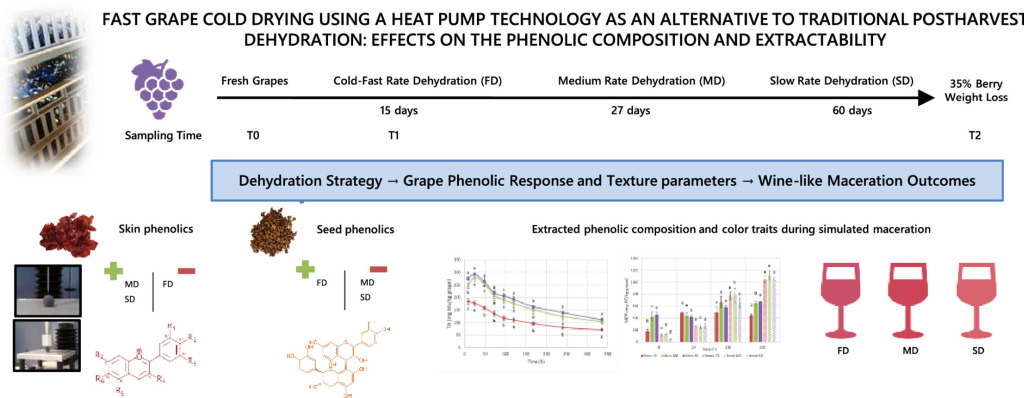
Cold drying technology aims to achieve fast water loss by relying on low relative humidity while avoiding high thermal stress on the product. The study compares its effect to two traditional dehydration conditions used to process grapes destined to special wine production, focusing on the preservation and extraction of anthocyanins and tannins in Vitis vinifera L. cv. ‘Nebbiolo’. Fast rate dehydration (FD) at 15 °C and 40% relative humidity (RH), medium rate dehydration (MD) at 25 °C and 40% RH, and slow rate dehydration (SD) at 10 °C and 75% RH were tested after 15 days and at 35% weight loss. Grape must composition, potential phenolic content of skin, seeds, and pulp, anthocyanin profile, and mechanical properties were assessed, as well as extracted phenolic content and color traits during 14-day simulated maceration in wine-like solution. FD, while achieving a 35% weight loss in the shortest time (15 days), did not preserve skin polyphenols, mostly decreasing the anthocyanin content, which limited the formation of polymeric pigments during maceration. FD also resulted in highest contents of seed phenolics. This fast dehydration may induce stress responses, skin structural changes or biochemical imbalances in grape tissues, compromising the preservation of phenolic compounds, especially from skins. MD showed better outputs, especially for anthocyanin retention and color preservation during maceration, whereas SD was also effective in preserving skin polyphenols, but longer dehydration promoted anthocyanin degradation. Shorter dehydration treatments remain useful to produce high quality special wines from partially dehydrated grapes, particularly to reduce storage time.
Key words cold drying, grape fast dehydration, grape texture, polyphenols, extractability, color characteristics, special wines
BibTeX entry: click to show
@article{
	2318_2147271,
	url = {https://hdl.handle.net/2318/2147271},
	author = {Cordero, Beatrice and Seif Zadeh, Negin and Biglia, Alessandro and Caudana, Alberto and Paissoni, Maria Alessandra and Ricauda Aimonino, Davide and Giacosa, Simone and Rolle, Luca and Río Segade, Susana},
	title = {Fast grape cold drying using a heat pump technology as an alternative to traditional postharvest dehydration: Effects on the phenolic composition and extractability},
	year = {2026},
	journal = {Applied Food Research},
	volume = {6},
	abstract = {Cold drying technology aims to achieve fast water loss by relying on low relative humidity while avoiding high thermal stress on the product. The study compares its effect to two traditional dehydration conditions used to process grapes destined to special wine production, focusing on the preservation and extraction of anthocyanins and tannins in Vitis vinifera L. cv. ‘Nebbiolo’. Fast rate dehydration (FD) at 15 °C and 40\% relative humidity (RH), medium rate dehydration (MD) at 25 °C and 40\% RH, and slow rate dehydration (SD) at 10 °C and 75\% RH were tested after 15 days and at 35\% weight loss. Grape must composition, potential phenolic content of skin, seeds, and pulp, anthocyanin profile, and mechanical properties were assessed, as well as extracted phenolic content and color traits during 14-day simulated maceration in wine-like solution. FD, while achieving a 35% weight loss in the shortest time (15 days), did not preserve skin polyphenols, mostly decreasing the anthocyanin content, which limited the formation of polymeric pigments during maceration. FD also resulted in highest contents of seed phenolics. This fast dehydration may induce stress responses, skin structural changes or biochemical imbalances in grape tissues, compromising the preservation of phenolic compounds, especially from skins. MD showed better outputs, especially for anthocyanin retention and color preservation during maceration, whereas SD was also effective in preserving skin polyphenols, but longer dehydration promoted anthocyanin degradation. Shorter dehydration treatments remain useful to produce high quality special wines from partially dehydrated grapes, particularly to reduce storage time.},
	keywords = {cold drying, grape fast dehydration, grape texture, polyphenols, extractability, color characteristics, special wines},
	doi = {10.1016/j.afres.2026.102258},
	pages = {102258}
}
Publication availability
Open access
This file is available in a open access version. It is possible to download this file and distribute it observing the limitations indicated in the license.
View or request this publication
You can find the postprint version of this article in the Open Access Repository of the University of Torino:
IRIS-AperTO record 2318/2147271
View the final version at publisher:
doi:10.1016/j.afres.2026.102258
File not available? Do you need further information?
You can contact me and request this article through the following form: