Articolo su rivista pubblicato in Food Chemistry, volume 529, pp. 151142.
Autori: .
Abstract
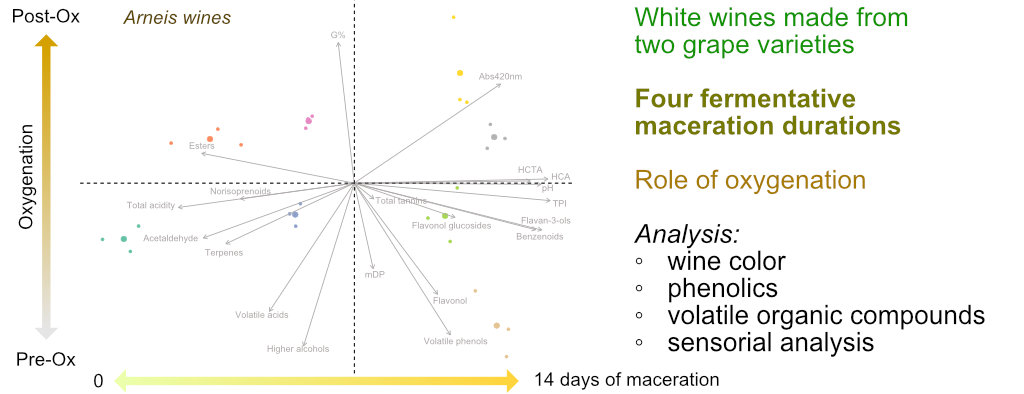
Fermentative skin contact is increasingly applied in white winemaking, yet its compositional and sensory consequences remain underexplored. This study evaluated Arneis and Erbaluce wines produced under four maceration regimes (0, 2, 7, and 14 days), as well as the effect of post-fermentative oxygenation for each wine obtained. Phenolic composition was quantified by LC-MS/MS and spectrophotometry, volatile compounds by GC-MS, and sensory attributes through a trained panel using a Rate-All-That-Apply (RATA) approach. Extended maceration substantially increased proanthocyanidins, flavan-3-ols, hydroxycinnamates, and flavonols, reaching levels comparable to red wines, while color shifted toward deeper yellow hues. Oxygenation reduced monomeric flavanols and esters and amplified oxidative notes. Sensory evaluation revealed heightened astringency and dryness in long-macerated samples, alongside diminished fruity aromas. These findings demonstrate that fermentative maceration strongly modulates the phenolic and aroma profiles of white wines, with oxygen exposure further refining their sensory expression.
Parole chiave maceration, oxidation, phenolic compounds, volatile compounds, aroma profile, mass spectrometry, white wines
codice BibTeX: clicca per mostrare
@article{
	2318_2160550,
	url = {https://hdl.handle.net/2318/2160550},
	author = {Ferrero, Lorenzo and Lagori, Marco and Kasianova, Anastasiia and Boido, Micaela and Botta, Giorgia and Cordero, Beatrice and Paissoni, Maria Alessandra and Río Segade, Susana and Rolle, Luca and Giacosa, Simone},
	title = {Exploring fermentative skin contact effects and post-fermentative oxidation on phenolics, aroma, and sensory characteristics in white wine},
	year = {2026},
	journal = {Food Chemistry},
	volume = {529},
	abstract = {Fermentative skin contact is increasingly applied in white winemaking, yet its compositional and sensory consequences remain underexplored. This study evaluated Arneis and Erbaluce wines produced under four maceration regimes (0, 2, 7, and 14 days), as well as the effect of post-fermentative oxygenation for each wine obtained. Phenolic composition was quantified by LC-MS/MS and spectrophotometry, volatile compounds by GC-MS, and sensory attributes through a trained panel using a Rate-All-That-Apply (RATA) approach. Extended maceration substantially increased proanthocyanidins, flavan-3-ols, hydroxycinnamates, and flavonols, reaching levels comparable to red wines, while color shifted toward deeper yellow hues. Oxygenation reduced monomeric flavanols and esters and amplified oxidative notes. Sensory evaluation revealed heightened astringency and dryness in long-macerated samples, alongside diminished fruity aromas. These findings demonstrate that fermentative maceration strongly modulates the phenolic and aroma profiles of white wines, with oxygen exposure further refining their sensory expression.},
	keywords = {maceration, oxidation, phenolic compounds, volatile compounds, aroma profile, mass spectrometry, white wines},
	doi = {10.1016/j.foodchem.2026.151142},
	pages = {151142}
}
Disponibilità della pubblicazione
Open access
Il file è disponibile in versione ad accesso aperto. È quindi possibile scaricarlo e diffonderlo secondo le limitazioni espresse nella licenza.
Materiale supplementare (da IRIS): File 1
Visualizza o richiedi la pubblicazione
È possibile trovare la versione postprint dell’articolo nell’archivio istituzionale dell’Università di Torino
IRIS-AperTO record 2318/2160550
Consulta la versione finale presso l’editore:
doi:10.1016/j.foodchem.2026.151142
File non disponibile? Servono informazioni?
Puoi contattarmi e richiedere il documento attraverso il seguente modulo: