Articolo su rivista pubblicato in Frontiers in Plant Science, volume 17, pp. 1804241.
Autori: .
Abstract
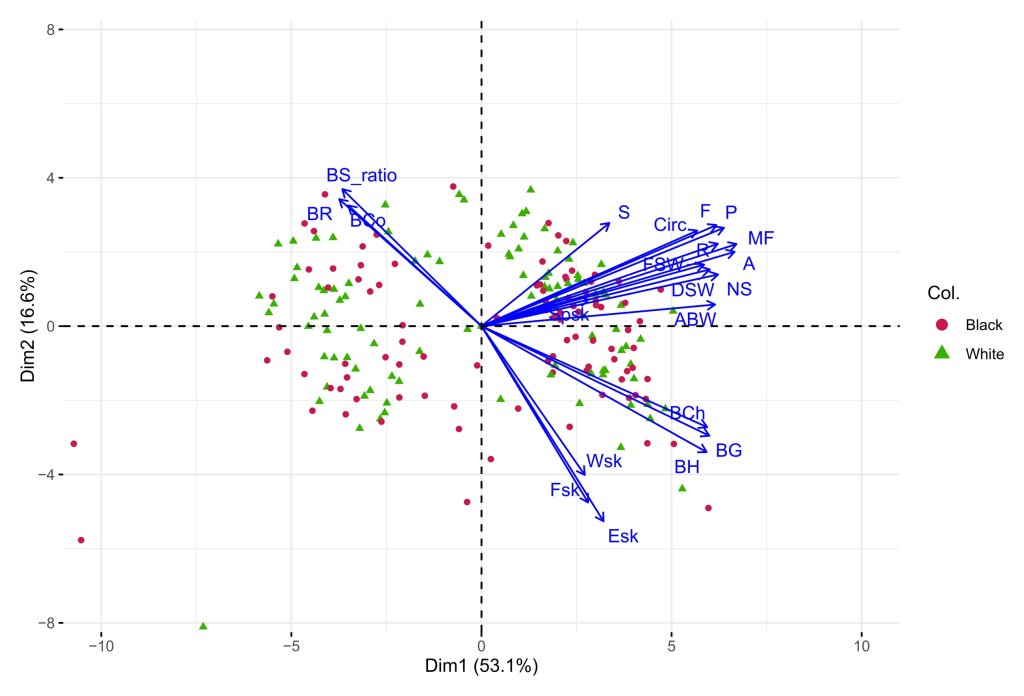
An F₁ population of 200 individuals derived from the cross between Raboso Veronese, a black-berried, seeded winegrape cultivar, and Sultanina, a white-berried, seedless table grape cultivar, was phenotyped for berry color and weight, 28 texture-related traits, seed number, and 11 seed size and morphology parameters, and genotyped through Single Primer Enrichment Technology (SPET) to dissect the genetic architecture of berry texture and defective seed development. High-density pseudo-testcross genetic maps were obtained for both parents, comprising, respectively, 1, 223 and 1, 238 SNP markers. Quantitative trait locus (QTL) analysis, performed using BLUPs of phenotypic data, revealed 12 closely located QTLs in Sultanina chromosome 18 associated to berry texture and/or seed traits, with LOD values up to 45 and explained phenotypic variation up to 65.49%. In addition, several minor-effect QTLs related to berry traits were detected: on chromosomes 11, 17, and 18 in Raboso Veronese, and on chromosome 11 in Sultanina. Although each locus individually explained a limited proportion of phenotypic variance, their combined effects supported the polygenic nature of berry mechanical properties. In silico analysis of genes within the identified QTL regions revealed functions consistent with roles in the genetic regulation of berry texture and seed development status, supporting the association of these regions with the observed phenotypic variation and providing a foundation for future in depth functional studies. Thanks to the accurate joint phenotyping of berry texture and seed development deficiency, the two parental maps allowed us to highlight several aspects of grape texture dynamics, underlining the link between seed development status and berry softening during ripening.
Parole chiave wine aging, typicality, grape varieties, terpenes, cineoles, dimethyl sulfide, methanethiol, methyl salicylate
codice BibTeX: clicca per mostrare
@article{
	2318_2140350,
	url = {https://hdl.handle.net/2318/2140350},
	author = {Biselli, Chiara and Fricano, Agostino and Crespan, Manna and Giacosa, Simone and Garavelloni, Simone and Valentini, Filippo Maria and Epifani, Anna Maria and Espinosa-Roldán, Francisco Emmanuel and Rolle, Luca},
	title = {A comprehensive SPET-based linkage mapping for berry texture and defective seed development in grapevine},
	year = {2026},
	journal = {Frontiers in Plant Science},
	volume = {17},
	abstract = {An F₁ population of 200 individuals derived from the cross between Raboso Veronese, a black-berried, seeded winegrape cultivar, and Sultanina, a white-berried, seedless table grape cultivar, was phenotyped for berry color and weight, 28 texture-related traits, seed number, and 11 seed size and morphology parameters, and genotyped through Single Primer Enrichment Technology (SPET) to dissect the genetic architecture of berry texture and defective seed development. High-density pseudo-testcross genetic maps were obtained for both parents, comprising, respectively, 1, 223 and 1, 238 SNP markers. Quantitative trait locus (QTL) analysis, performed using BLUPs of phenotypic data, revealed 12 closely located QTLs in Sultanina chromosome 18 associated to berry texture and/or seed traits, with LOD values up to 45 and explained phenotypic variation up to 65.49\%. In addition, several minor-effect QTLs related to berry traits were detected: on chromosomes 11, 17, and 18 in Raboso Veronese, and on chromosome 11 in Sultanina. Although each locus individually explained a limited proportion of phenotypic variance, their combined effects supported the polygenic nature of berry mechanical properties. In silico analysis of genes within the identified QTL regions revealed functions consistent with roles in the genetic regulation of berry texture and seed development status, supporting the association of these regions with the observed phenotypic variation and providing a foundation for future in depth functional studies. Thanks to the accurate joint phenotyping of berry texture and seed development deficiency, the two parental maps allowed us to highlight several aspects of grape texture dynamics, underlining the link between seed development status and berry softening during ripening.},
	keywords = {wine aging, typicality, grape varieties, terpenes, cineoles, dimethyl sulfide, methanethiol, methyl salicylate},
	doi = {10.3389/fpls.2026.1804241},
	pages = {1804241}
}
Disponibilità della pubblicazione
Open access
Il file è disponibile in versione ad accesso aperto. È quindi possibile scaricarlo e diffonderlo secondo le limitazioni espresse nella licenza.
Visualizza o richiedi la pubblicazione
È possibile trovare la versione postprint dell’articolo nell’archivio istituzionale dell’Università di Torino
IRIS-AperTO record 2318/2140350
Consulta la versione finale presso l’editore:
doi:10.3389/fpls.2026.1804241
File non disponibile? Servono informazioni?
Puoi contattarmi e richiedere il documento attraverso il seguente modulo: