Articolo su rivista pubblicato in Food Chemistry: Molecular Sciences, volume 12, pp. 100397.
Autori: .
Abstract
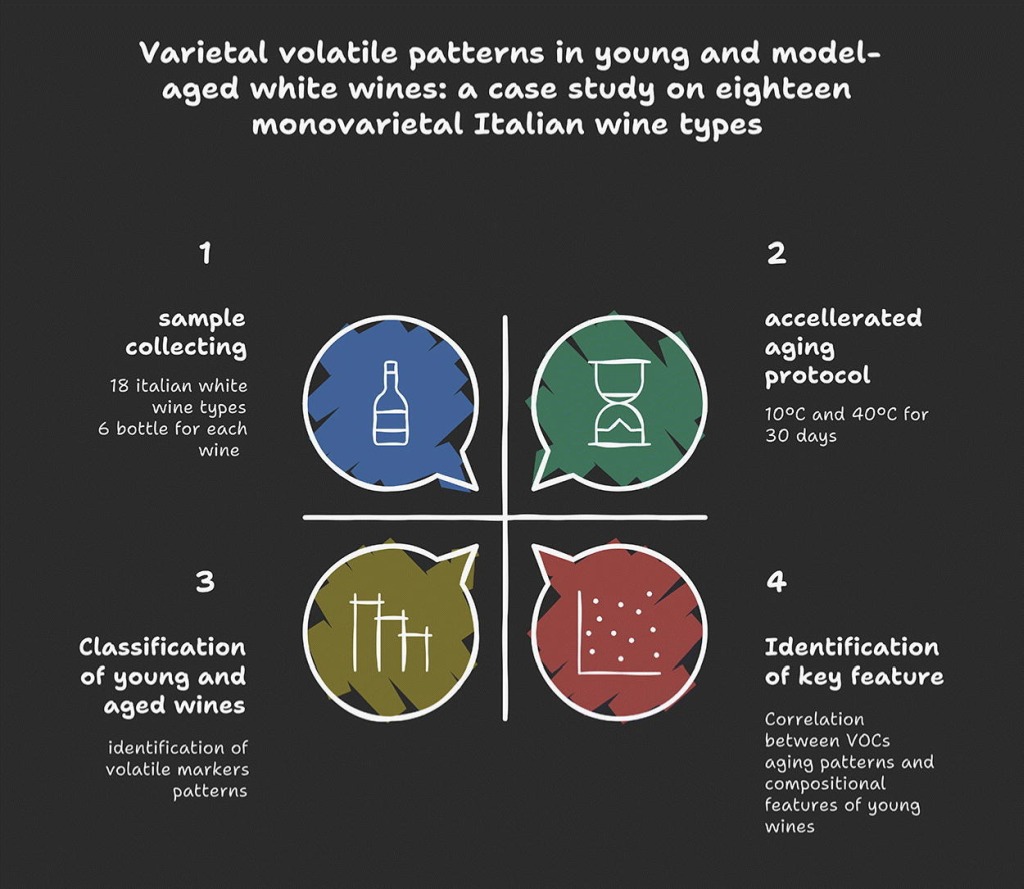
During aging, wines undergo substantial compositional transformation through complex reactions impacting wine volatile composition. Most white wines are obtained from aromatically neutral grape varieties, although aging might induce chemical changes of potential relevance for viticulture and enology. This study investigated aging-induced changes in varietal volatile compounds across 18 monovarietal white wine types from nine Italian regions, namely Albana, Cortese, Arneis, Erbaluce, Falanghina, Fiano, Garganega, Gewürztraminer, Greco di Tufo, Lugana, Müller-Thurgau, Nosiola, Pallagrello bianco, Pinot grigio, Ribolla gialla, Verdicchio, Vermentino, and Vernaccia. Results provided for the first time clear chemical clues about the existence of distinct aging patterns for each wine type. Aging treatment enhanced classification complexity while simultaneously reducing intra-varietal diversity. Certain wines developed characteristic patterns and markers during aging. In particular, compounds such as methyl salicylate, cineole isomers, dimethyl sulfide (DMS) and methanethiol were primarily associated with specific varietal types. These findings provide insights for optimizing viticultural and winemaking strategies to manage varietal typicality during aging.
Parole chiave wine aging, typicality, grape varieties, terpenes, cineoles, dimethyl sulfide, methanethiol, methyl salicylate
codice BibTeX: clicca per mostrare
@article{
	2318_2137570,
	url = {https://hdl.handle.net/2318/2137570},
	author = {Luzzini, Giovanni and Furlan, Nicole and Slaghenaufi, Davide and Piergiovanni, Maurizio and Carlin, Silvia and Mattivi, Fulvio and Río Segade, Susana and Giacosa, Simone and Piombino, Paola and Pittari, Elisabetta and Parpinello, Giuseppina Paola and Ricci, Arianna and Marangon, Matteo and Marangon, Christine Mayr and Ugliano, Maurizio},
	title = {Varietal volatile patterns in young and model-aged white wines: a case study on eighteen monovarietal Italian wine types},
	year = {2026},
	journal = {Food Chemistry: Molecular Sciences},
	volume = {12},
	abstract = {During aging, wines undergo substantial compositional transformation through complex reactions impacting wine volatile composition. Most white wines are obtained from aromatically neutral grape varieties, although aging might induce chemical changes of potential relevance for viticulture and enology. This study investigated aging-induced changes in varietal volatile compounds across 18 monovarietal white wine types from nine Italian regions, namely Albana, Cortese, Arneis, Erbaluce, Falanghina, Fiano, Garganega, Gewürztraminer, Greco di Tufo, Lugana, Müller-Thurgau, Nosiola, Pallagrello bianco, Pinot grigio, Ribolla gialla, Verdicchio, Vermentino, and Vernaccia. Results provided for the first time clear chemical clues about the existence of distinct aging patterns for each wine type. Aging treatment enhanced classification complexity while simultaneously reducing intra-varietal diversity. Certain wines developed characteristic patterns and markers during aging. In particular, compounds such as methyl salicylate, cineole isomers, dimethyl sulfide (DMS) and methanethiol were primarily associated with specific varietal types. These findings provide insights for optimizing viticultural and winemaking strategies to manage varietal typicality during aging.},
	keywords = {wine aging, typicality, grape varieties, terpenes, cineoles, dimethyl sulfide, methanethiol, methyl salicylate},
	doi = {10.1016/j.fochms.2026.100397},
	pages = {100397}
}
Disponibilità della pubblicazione
Open access
Il file è disponibile in versione ad accesso aperto. È quindi possibile scaricarlo e diffonderlo secondo le limitazioni espresse nella licenza.
Materiale supplementare (da IRIS): File 1
Visualizza o richiedi la pubblicazione
È possibile trovare la versione postprint dell’articolo nell’archivio istituzionale dell’Università di Torino
IRIS-AperTO record 2318/2137570
Consulta la versione finale presso l’editore:
doi:10.1016/j.fochms.2026.100397
File non disponibile? Servono informazioni?
Puoi contattarmi e richiedere il documento attraverso il seguente modulo: