Articolo su rivista pubblicato in Beverages, volume 11, pp. 161.
Autori: .
Abstract
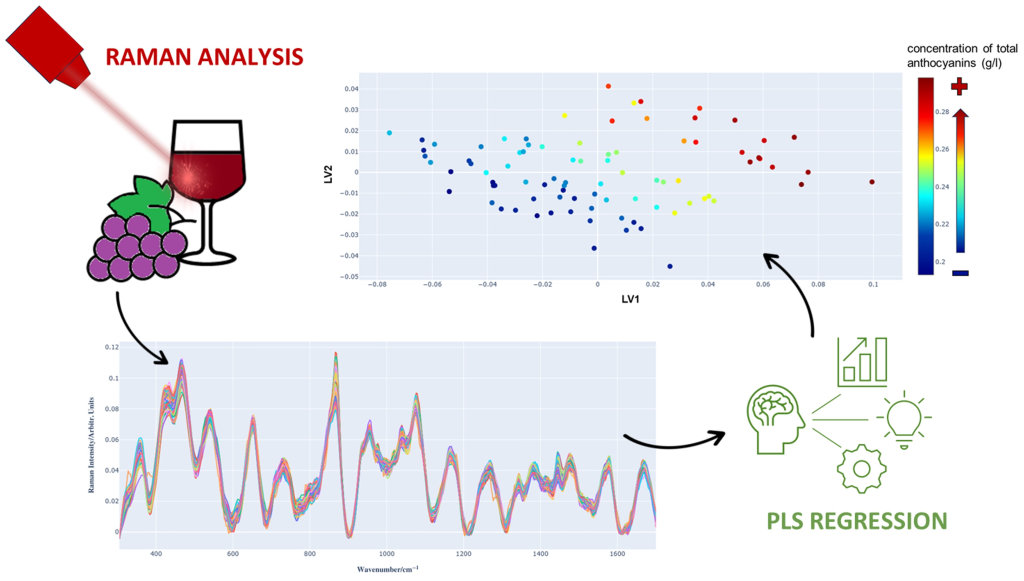
The quantity of anthocyanins plays a crucial role in wine quality, since these phenolic compounds significantly influence the color, mouthfeel and organoleptic properties of red wines. It is therefore important to define accurate and precise methodologies to monitor the concentration of total anthocyanins in wine. Currently, this analysis is carried out using Ultraviolet-Visible (UV–visible) spectrophotometry. This work aims to determine an alternative methodology that is equally fast, accurate and allows in situ measurements while opening the measurement of the concentrations of other molecules of interest. The method presented consists of Raman analysis of Barbera wine samples using a portable Raman spectroscopy system. Subsequently, the collected spectra were processed using an algorithm that applies partial least squares (PLS) regression, making it possible to determine the concentration of total anthocyanins for each sample. This approach is characterized by an accuracy and precision comparable to the methodology currently in use, i.e., UV–visible spectrophotometry. It is indeed characterized by an RMSE (root mean square error) and R² (the coefficient of determination) on the validation set of 0.010 g/L and 0.88 and on the test data of 0.007 g/L and 0.93, respectively.
Parole chiave wine, anthocyanin, Raman spectroscopy, chemometrics, PLS regression
codice BibTeX: clicca per mostrare
@article{
	2318_2113190,
	url = {https://hdl.handle.net/2318/2113190},
	author = {Gilioli, Anna Lisa and Sacco, Alessio and Giovannozzi, Andrea Mario and Giacosa, Simone and Bosso, Antonella and Panero, Loretta and Ferrero, Lorenzo and Barera, Silvia Raffaela and Messina, Stefano and Lagori, Marco and Motta, Silvia and Guaita, Massimo and Vittone, Ettore and Rossi, Andrea Mario},
	title = {Determination of total anthocyanin concentration in Barbera red wines by Raman spectroscopy and multivariate statistical methods},
	year = {2025},
	journal = {Beverages},
	volume = {11},
	abstract = {The quantity of anthocyanins plays a crucial role in wine quality, since these phenolic compounds significantly influence the color, mouthfeel and organoleptic properties of red wines. It is therefore important to define accurate and precise methodologies to monitor the concentration of total anthocyanins in wine. Currently, this analysis is carried out using Ultraviolet-Visible (UV–visible) spectrophotometry. This work aims to determine an alternative methodology that is equally fast, accurate and allows in situ measurements while opening the measurement of the concentrations of other molecules of interest. The method presented consists of Raman analysis of Barbera wine samples using a portable Raman spectroscopy system. Subsequently, the collected spectra were processed using an algorithm that applies partial least squares (PLS) regression, making it possible to determine the concentration of total anthocyanins for each sample. This approach is characterized by an accuracy and precision comparable to the methodology currently in use, i.e., UV–visible spectrophotometry. It is indeed characterized by an RMSE (root mean square error) and R² (the coefficient of determination) on the validation set of 0.010 g/L and 0.88 and on the test data of 0.007 g/L and 0.93, respectively.},
	keywords = {wine, anthocyanin, Raman spectroscopy, chemometrics, PLS regression},
	doi = {10.3390/beverages11060161},
	pages = {161},
	number = {6}
}
Disponibilità della pubblicazione
Open access
Il file è disponibile in versione ad accesso aperto. È quindi possibile scaricarlo e diffonderlo secondo le limitazioni espresse nella licenza.
Visualizza o richiedi la pubblicazione
È possibile trovare la versione postprint dell’articolo nell’archivio istituzionale dell’Università di Torino
IRIS-AperTO record 2318/2113190
Consulta la versione finale presso l’editore:
doi:10.3390/beverages11060161
File non disponibile? Servono informazioni?
Puoi contattarmi e richiedere il documento attraverso il seguente modulo: