Articolo su rivista pubblicato in Food Chemistry, volume 482, pp. 144159.
Autori: .
Abstract
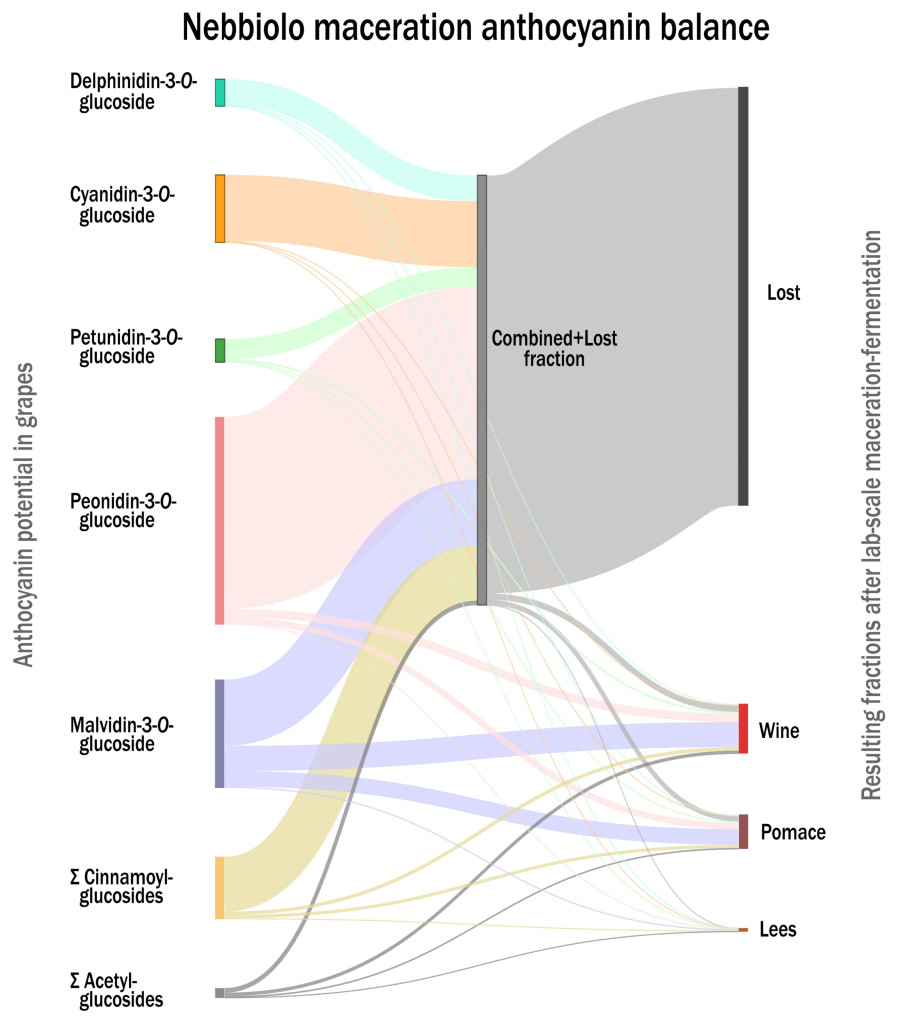
This study investigates the effects of maceration temperature (24 or 29 °C) and duration (12, 18, or 24 days) on phenolic compounds during ‘Nebbiolo’ wine-like extraction and lab-scale winemaking. In wine-like maceration, anthocyanins quickly peaked and then decreased, with temperature alone showing limited influence on extraction or degradation. In lab-scale fermentations, the rapid anthocyanin extraction at 29 °C was followed by higher degradation, driven by fermentative enzymatic activities and evidenced by increased skin softening at higher temperatures. Longer macerations led to less wine anthocyanins. Tri-substituted anthocyanins were better preserved at 24 °C. Tannin content and structure were minimally affected. Phenolic analyses of grapes, wine, pomace, and lees revealed the extracted, unextracted, resorbed, and degraded phenolic fractions. Reduced anthocyanins in pomace at higher temperatures or extended maceration indicated enhanced extraction and subsequent degradation. The study introduces a “phenolic budget” concept, highlighting the interplay of maceration parameters shaping ‘Nebbiolo’ wine phenolics.
Parole chiave grape proanthocyanidins, tannin extraction curves, phenolic compounds, simulated maceration
codice BibTeX: clicca per mostrare
@article{
	2318_2065490,
	url = {https://hdl.handle.net/2318/2065490},
	author = {Ferrero, Lorenzo and Beria D’Argentina, Sofia and Paissoni, Maria Alessandra and Río Segade, Susana and Rolle, Luca and Giacosa, Simone},
	title = {Phenolic budget in red winemaking: Influence of maceration temperature and time},
	year = {2025},
	journal = {Food Chemistry},
	volume = {482},
	abstract = {This study investigates the effects of maceration temperature (24 or 29 °C) and duration (12, 18, or 24 days) on phenolic compounds during ‘Nebbiolo’ wine-like extraction and lab-scale winemaking. In wine-like maceration, anthocyanins quickly peaked and then decreased, with temperature alone showing limited influence on extraction or degradation. In lab-scale fermentations, the rapid anthocyanin extraction at 29 °C was followed by higher degradation, driven by fermentative enzymatic activities and evidenced by increased skin softening at higher temperatures. Longer macerations led to less wine anthocyanins. Tri-substituted anthocyanins were better preserved at 24 °C. Tannin content and structure were minimally affected. Phenolic analyses of grapes, wine, pomace, and lees revealed the extracted, unextracted, resorbed, and degraded phenolic fractions. Reduced anthocyanins in pomace at higher temperatures or extended maceration indicated enhanced extraction and subsequent degradation. The study introduces a “phenolic budget” concept, highlighting the interplay of maceration parameters shaping ‘Nebbiolo’ wine phenolics.},
	keywords = {grape proanthocyanidins, tannin extraction curves, phenolic compounds, simulated maceration},
	doi = {10.1016/j.foodchem.2025.144159},
	pages = {144159}
}
Disponibilità della pubblicazione
Open access
Il file è disponibile in versione ad accesso aperto. È quindi possibile scaricarlo e diffonderlo secondo le limitazioni espresse nella licenza.
Materiale supplementare (da IRIS): File 1
Visualizza o richiedi la pubblicazione
È possibile trovare la versione postprint dell’articolo nell’archivio istituzionale dell’Università di Torino
IRIS-AperTO record 2318/2065490
Consulta la versione finale presso l’editore:
doi:10.1016/j.foodchem.2025.144159
File non disponibile? Servono informazioni?
Puoi contattarmi e richiedere il documento attraverso il seguente modulo: