Journal article published in Food Chemistry, volume 482, pp. 144159.
Authors: .
Abstract
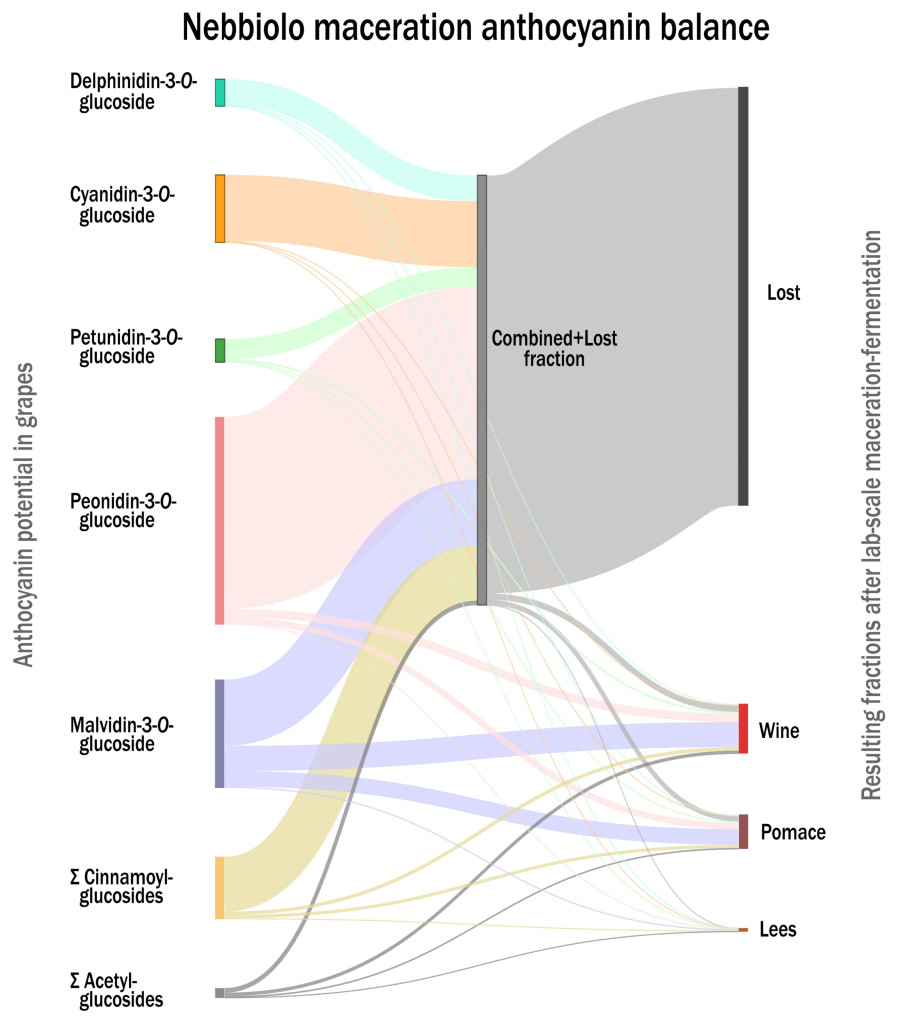
This study investigates the effects of maceration temperature (24 or 29 °C) and duration (12, 18, or 24 days) on phenolic compounds during ‘Nebbiolo’ wine-like extraction and lab-scale winemaking. In wine-like maceration, anthocyanins quickly peaked and then decreased, with temperature alone showing limited influence on extraction or degradation. In lab-scale fermentations, the rapid anthocyanin extraction at 29 °C was followed by higher degradation, driven by fermentative enzymatic activities and evidenced by increased skin softening at higher temperatures. Longer macerations led to less wine anthocyanins. Tri-substituted anthocyanins were better preserved at 24 °C. Tannin content and structure were minimally affected. Phenolic analyses of grapes, wine, pomace, and lees revealed the extracted, unextracted, resorbed, and degraded phenolic fractions. Reduced anthocyanins in pomace at higher temperatures or extended maceration indicated enhanced extraction and subsequent degradation. The study introduces a “phenolic budget” concept, highlighting the interplay of maceration parameters shaping ‘Nebbiolo’ wine phenolics.
Key words grape proanthocyanidins, tannin extraction curves, phenolic compounds, simulated maceration
BibTeX entry: click to show
@article{
	2318_2065490,
	url = {https://hdl.handle.net/2318/2065490},
	author = {Ferrero, Lorenzo and Beria D’Argentina, Sofia and Paissoni, Maria Alessandra and Río Segade, Susana and Rolle, Luca and Giacosa, Simone},
	title = {Phenolic budget in red winemaking: Influence of maceration temperature and time},
	year = {2025},
	journal = {Food Chemistry},
	volume = {482},
	abstract = {This study investigates the effects of maceration temperature (24 or 29 °C) and duration (12, 18, or 24 days) on phenolic compounds during ‘Nebbiolo’ wine-like extraction and lab-scale winemaking. In wine-like maceration, anthocyanins quickly peaked and then decreased, with temperature alone showing limited influence on extraction or degradation. In lab-scale fermentations, the rapid anthocyanin extraction at 29 °C was followed by higher degradation, driven by fermentative enzymatic activities and evidenced by increased skin softening at higher temperatures. Longer macerations led to less wine anthocyanins. Tri-substituted anthocyanins were better preserved at 24 °C. Tannin content and structure were minimally affected. Phenolic analyses of grapes, wine, pomace, and lees revealed the extracted, unextracted, resorbed, and degraded phenolic fractions. Reduced anthocyanins in pomace at higher temperatures or extended maceration indicated enhanced extraction and subsequent degradation. The study introduces a “phenolic budget” concept, highlighting the interplay of maceration parameters shaping ‘Nebbiolo’ wine phenolics.},
	keywords = {grape proanthocyanidins, tannin extraction curves, phenolic compounds, simulated maceration},
	doi = {10.1016/j.foodchem.2025.144159},
	pages = {144159}
}
Publication availability
Open access
This file is available in a open access version. It is possible to download this file and distribute it observing the limitations indicated in the license.
Supplementary material (from IRIS): File 1
View or request this publication
You can find the postprint version of this article in the Open Access Repository of the University of Torino:
IRIS-AperTO record 2318/2065490
View the final version at publisher:
doi:10.1016/j.foodchem.2025.144159
File not available? Do you need further information?
You can contact me and request this article through the following form: