Journal article published in Food and Bioprocess Technology, volume 18, pp. 5767–5781.
Authors: .
Abstract
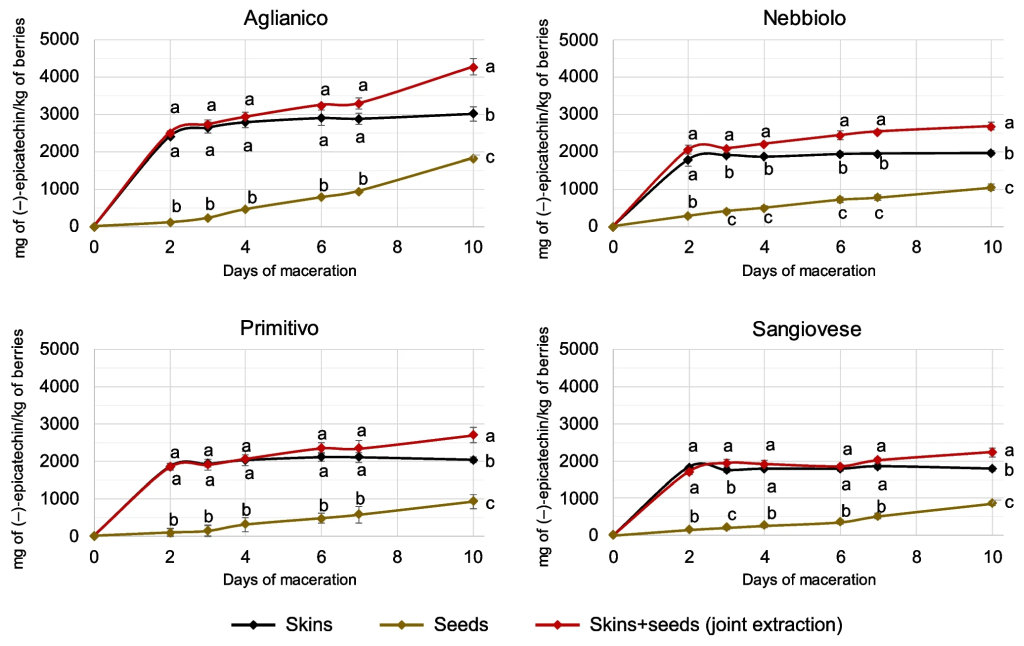
This study investigated tannin extraction in four Italian red grape varieties — ‘Aglianico’, ‘Nebbiolo’, ‘Primitivo’, and ‘Sangiovese’. The grape initial tannin content was characterized through a potential extraction. Moreover, the extractable phenolic content was evaluated through maceration in wine-like solution of skins, seeds, and their combinations for 10 days, with ethanol concentration incrementally adjusted to simulate fermentation. Texture analysis of grape seeds and skins was conducted before and after the wine-like solution macerations. Results revealed variety-dependent differences in the mechanical and acoustic properties of grape skins and seeds, with seeds showing increased acoustic energy upon breakage. Grape varieties showed differences in skin and seed phenolic pools and extractability. Significant positive correlations were found between potential and extractable tannin content. Smaller, less galloylated flavan-3-ols were well extracted in model wine solutions. Extraction curves were examined from skins, seeds, and combined skins + seeds matrices, evidencing a faster skin phenolics extraction than seeds. Interestingly, tannin extraction from skins + seeds did not correspond to the sum of individual skin and seed extractions. Moreover, the skin-to-seed tannin ratio and tannin structural characteristics also varied between skin and seed joint and separate extractions.
Key words grape proanthocyanidins, tannin extraction curves, phenolic compounds, simulated maceration
BibTeX entry: click to show
@article{
	2318_2063372,
	url = {https://hdl.handle.net/2318/2063372},
	author = {Ferrero, Lorenzo and Paissoni, Maria Alessandra and Río Segade, Susana and Mattivi, Fulvio and Marangon, Matteo and Parpinello, Giuseppina Paola and Piombino, Paola and Ugliano, Maurizio and Gerbi, Vincenzo and Rolle, Luca and Giacosa, Simone},
	title = {Insight on tannin extraction and mechanical changes during maceration from skins and seeds of Italian red grape varieties},
	year = {2025},
	journal = {Food and Bioprocess Technology},
	volume = {18},
	abstract = {This study investigated tannin extraction in four Italian red grape varieties — ‘Aglianico’, ‘Nebbiolo’, ‘Primitivo’, and ‘Sangiovese’. The grape initial tannin content was characterized through a potential extraction. Moreover, the extractable phenolic content was evaluated through maceration in wine-like solution of skins, seeds, and their combinations for 10 days, with ethanol concentration incrementally adjusted to simulate fermentation. Texture analysis of grape seeds and skins was conducted before and after the wine-like solution macerations. Results revealed variety-dependent differences in the mechanical and acoustic properties of grape skins and seeds, with seeds showing increased acoustic energy upon breakage. Grape varieties showed differences in skin and seed phenolic pools and extractability. Significant positive correlations were found between potential and extractable tannin content. Smaller, less galloylated flavan-3-ols were well extracted in model wine solutions. Extraction curves were examined from skins, seeds, and combined skins + seeds matrices, evidencing a faster skin phenolics extraction than seeds. Interestingly, tannin extraction from skins + seeds did not correspond to the sum of individual skin and seed extractions. Moreover, the skin-to-seed tannin ratio and tannin structural characteristics also varied between skin and seed joint and separate extractions.},
	keywords = {grape proanthocyanidins, tannin extraction curves, phenolic compounds, simulated maceration},
	doi = {10.1007/s11947-025-03806-9},
	pages = {5767--5781}
}
Publication availability
Open access
This file is available in a open access version. It is possible to download this file and distribute it observing the limitations indicated in the license.
Supplementary material (from IRIS): File 1
View or request this publication
You can find the postprint version of this article in the Open Access Repository of the University of Torino:
IRIS-AperTO record 2318/2063372
View the final version at publisher:
doi:10.1007/s11947-025-03806-9
File not available? Do you need further information?
You can contact me and request this article through the following form: