Articolo su rivista pubblicato in American Journal of Enology and Viticulture, volume 63, pp. 195–204.
Autori: .
Abstract
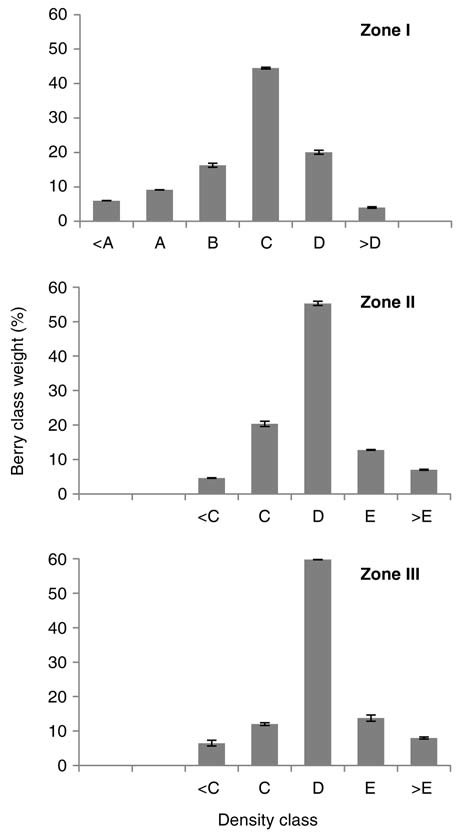
In vineyards, the existence of in-field grape variability attributable to environmental factors can induce differences in the ripening process and, therefore, in the physicochemical characteristics of the grape berries. This variability is often higher among different growing locations. Automatic, densimetric berry-sorting machines have recently been developed and proposed for use in wineries to reduce this variability, thereby making the grape quality uniform in terms of density. Densimetric sorting requires the selection of a density value according to objective quality parameters of the berries. The aim of this work was to determine the relationships among different objective quality parameters of Nebbiolo grapes harvested on the same date, such as mechanical properties, phenolic composition and extractability indices; to determine the berry density estimated by flotation in different salt solutions of densities ranging from 1069 to 1125 kg m^3; and to investigate the influence of the growing location on these relationships. The results revealed that the most promising physicochemical parameters for determining the appropriate density are the total anthocyanin and flavonoid concentrations in the skins, the total flavonoid and oligomer proanthocyanidin contents in the seeds, as well as skin hardness and thickness. Nevertheless, density selection must be performed for each individual vineyard or homogeneous group of vineyards belonging to the same production zone because the correlation of the berry density with these parameters also depends on the vineyard effect. The results of densimetric sorting of berries are attractive because this emerging technology can be pursued to separate grapes with different quality parameters.
Parole chiave grape density; skin hardness; cellular maturity index; anthocyanins; proanthocyanidins; red grape
codice BibTeX: clicca per mostrare
@article{
	2318_88820,
	url = {https://hdl.handle.net/2318/88820},
	author = {Rolle, Luca and Torchio, Fabrizio and Giacosa, Simone and Río Segade, Susana and Cagnasso, Enzo and Gerbi, Vincenzo},
	title = {Assessment of physicochemical differences in Nebbiolo grape berries from different production areas sorted by flotation},
	year = {2012},
	journal = {American Journal of Enology and Viticulture},
	volume = {63},
	abstract = {In vineyards, the existence of in-field grape variability attributable to environmental factors can induce differences in the ripening process and, therefore, in the physicochemical characteristics of the grape berries. This variability is often higher among different growing locations. Automatic, densimetric berry-sorting machines have recently been developed and proposed for use in wineries to reduce this variability, thereby making the grape quality uniform in terms of density. Densimetric sorting requires the selection of a density value according to objective quality parameters of the berries. The aim of this work was to determine the relationships among different objective quality parameters of Nebbiolo grapes harvested on the same date, such as mechanical properties, phenolic composition and extractability indices; to determine the berry density estimated by flotation in different salt solutions of densities ranging from 1069 to 1125 kg m^3; and to investigate the influence of the growing location on these relationships. The results revealed that the most promising physicochemical parameters for determining the appropriate density are the total anthocyanin and flavonoid concentrations in the skins, the total flavonoid and oligomer proanthocyanidin contents in the seeds, as well as skin hardness and thickness. Nevertheless, density selection must be performed for each individual vineyard or homogeneous group of vineyards belonging to the same production zone because the correlation of the berry density with these parameters also depends on the vineyard effect. The results of densimetric sorting of berries are attractive because this emerging technology can be pursued to separate grapes with different quality parameters.},
	keywords = {grape density; skin hardness; cellular maturity index; anthocyanins; proanthocyanidins; red grape},
	doi = {10.5344/ajev.2012.11069},
	pages = {195--204}
}
Disponibilità della pubblicazione
Non ancora disponibile qui
Il file non è ancora disponibile qui a causa della licenza d’uso. Contattami per maggiori informazioni.
Visualizza o richiedi la pubblicazione
È possibile trovare la versione postprint dell’articolo nell’archivio istituzionale dell’Università di Torino
IRIS-AperTO record 2318/88820
Consulta la versione finale presso l’editore:
doi:10.5344/ajev.2012.11069
File non disponibile? Servono informazioni?
Puoi contattarmi e richiedere il documento attraverso il seguente modulo: