Articolo su rivista pubblicato in Applied Microbiology and Biotechnology, volume 103, pp. 7687–7702.
Autori: .
Abstract
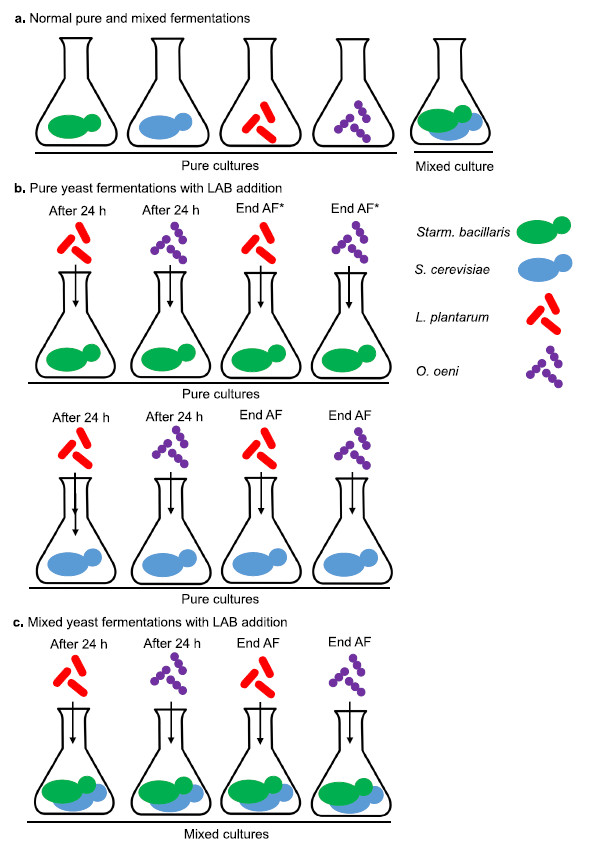
In recent years, there is an increasing interest from the winemaking industry for the use of mixed fermentations with Starmerella bacillaris (synonym Candida zemplinina) and Saccharomyces cerevisiae, due to their ability to modulate metabolites of oenological interest. The current study was carried out to elucidate the effect of this fermentation protocol on the growth and malolactic activity of lactic acid bacteria (LAB) used for malolactic fermentation (MLF) and on the chemical and volatile profile of Nebbiolo wines and their chromatic characteristics. To this end, two LAB species, namely Lactobacillus plantarum and Oenococcus oeni, were inoculated at the beginning and at the end of the alcoholic fermentation (AF) performed by pure and mixed yeast using the abovementioned yeasts. The different yeast inoculation protocols and the combination of species tested influenced greatly the interactions and behavior of the inoculated yeasts and LAB during AF and MLF. For both LAB species, inoculation timing was critical to how rapidly MLF started and finished. Fermentation inoculated with L. plantarum, at the beginning of the AF, completed MLF faster than those inoculated with O. oeni. The presence of Starm. bacillaris in mixed fermentation promoted LAB growth and activity, in particular, O. oeni. Furthermore, LAB species choice had a greater impact on the volatile and chromatic profile of the wines than inoculation time. These findings reveal new knowledge about the importance of LAB species choice and inoculation time to ensure fast MLF completion and to improve wine characteristics in mixed fermentation with Starm. bacillaris and S. cerevisiae.
Parole chiave Starmerella bacillaris; Saccharomyces cerevisiae; Oenococcus oeni; Lactobacillus plantarum; interactions; malolactic fermentation
codice BibTeX: clicca per mostrare
@article{
	2318_1710440,
	url = {https://hdl.handle.net/2318/1710440},
	author = {Englezos, Vasileios and Castrillo Cachón, David and Rantsiou, Kalliopi and Blanco, Pilar and Petrozziello, Maurizio and Pollon, Matteo and Giacosa, Simone and Río Segade, Susana and Rolle, Luca and Cocolin, Luca},
	title = {Effect of mixed species alcoholic fermentation on growth and malolactic activity of lactic acid bacteria},
	year = {2019},
	journal = {Applied Microbiology and Biotechnology},
	volume = {103},
	abstract = {In recent years, there is an increasing interest from the winemaking industry for the use of mixed fermentations with Starmerella bacillaris (synonym Candida zemplinina) and Saccharomyces cerevisiae, due to their ability to modulate metabolites of oenological interest. The current study was carried out to elucidate the effect of this fermentation protocol on the growth and malolactic activity of lactic acid bacteria (LAB) used for malolactic fermentation (MLF) and on the chemical and volatile profile of Nebbiolo wines and their chromatic characteristics. To this end, two LAB species, namely Lactobacillus plantarum and Oenococcus oeni, were inoculated at the beginning and at the end of the alcoholic fermentation (AF) performed by pure and mixed yeast using the abovementioned yeasts. The different yeast inoculation protocols and the combination of species tested influenced greatly the interactions and behavior of the inoculated yeasts and LAB during AF and MLF. For both LAB species, inoculation timing was critical to how rapidly MLF started and finished. Fermentation inoculated with L. plantarum, at the beginning of the AF, completed MLF faster than those inoculated with O. oeni. The presence of Starm. bacillaris in mixed fermentation promoted LAB growth and activity, in particular, O. oeni. Furthermore, LAB species choice had a greater impact on the volatile and chromatic profile of the wines than inoculation time. These findings reveal new knowledge about the importance of LAB species choice and inoculation time to ensure fast MLF completion and to improve wine characteristics in mixed fermentation with Starm. bacillaris and S. cerevisiae.},
	keywords = {Starmerella bacillaris; Saccharomyces cerevisiae; Oenococcus oeni; Lactobacillus plantarum; interactions; malolactic fermentation},
	doi = {10.1007/s00253-019-10064-1},
	pages = {7687--7702}
}
Disponibilità della pubblicazione
Non ancora disponibile qui
Il file non è ancora disponibile qui a causa della licenza d’uso. Contattami per maggiori informazioni.
Visualizza o richiedi la pubblicazione
È possibile trovare la versione postprint dell’articolo nell’archivio istituzionale dell’Università di Torino
IRIS-AperTO record 2318/1710440
Consulta la versione finale presso l’editore:
doi:10.1007/s00253-019-10064-1
File non disponibile? Servono informazioni?
Puoi contattarmi e richiedere il documento attraverso il seguente modulo: