Articolo su rivista pubblicato in Journal of Food Composition and Analysis, volume 62, pp. 14–22.
Autori: .
Abstract
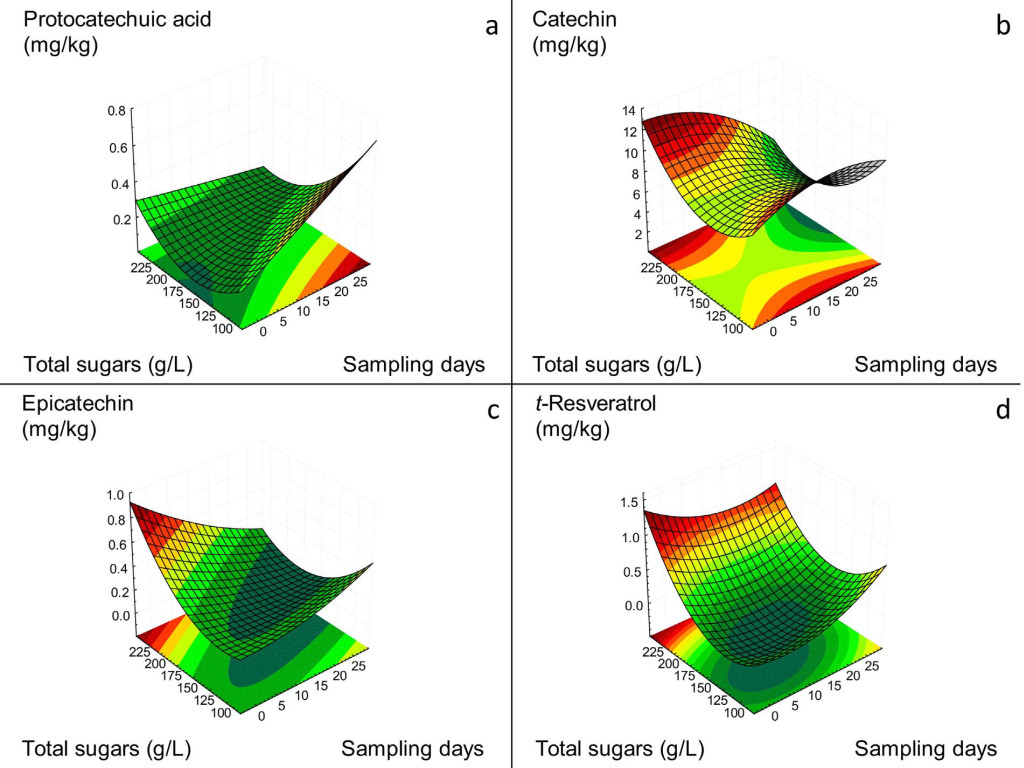
The aim of this work was to determine the phenolic profile of Vitis vinifera L. cv. "Italia" table grapes during ripening, as influenced by the harvest date and berry heterogeneity. The results showed that this cultivar is rich in phenolic compounds with health-promoting properties, particularly at early harvest stage (341 and 178 mg/kg berries of total phenols in the skin and pulp, respectively). Caftaric acid was the most abundant compound in the skin (28.95–51.93 mg/kg), while p-coumaroyl-glucose was the highest in the pulp (6.39–17.18 mg/kg). Low levels of resveratrol (0.11–0.29 mg/kg) were found in the skin starting from day 14 of the harvest. Response surface methodology (RSM) was used to model the evolution of phenolic compounds in berries during ripening. The regression models were highly significant for protocatechuic acid, catechin, epicatechin and t-resveratrol in the skin, and total hydroxycinnamoyl tartaric acids in the pulp (R ≥ 0.80). This modeling could be a tool that would permit better exploitation of maximum accumulation of phenolic compounds in the vineyard by selecting the most suitable combination of sampling date and berry density. An adequate sampling strategy could be implemented to increase the content of specific bioactive phenolic compounds according to consumer preference, thus promoting the health-promoting quality of fresh table grapes and ready-to-eat fruit salads.
Parole chiave berry density; epicatechin; ferulic acid; HCTA index; HPLC-MS/MS; resveratrol; ripening; table grapes; Vitis vinifera
codice BibTeX: clicca per mostrare
@article{
	2318_1641053,
	url = {https://hdl.handle.net/2318/1641053},
	author = {Belviso, Simona and Torchio, Fabrizio and Novello, Vittorino and Giacosa, Simone and de Palma, Laura and Río Segade, Susana and Gerbi, Vincenzo and Rolle, Luca},
	title = {Modeling of the evolution of phenolic compounds in berries of ``Italia'' table grape cultivar using response surface methodology},
	year = {2017},
	journal = {Journal of Food Composition and Analysis},
	volume = {62},
	abstract = {The aim of this work was to determine the phenolic profile of Vitis vinifera L. cv. ``Italia'' table grapes during ripening, as influenced by the harvest date and berry heterogeneity. The results showed that this cultivar is rich in phenolic compounds with health-promoting properties, particularly at early harvest stage (341 and 178 mg/kg berries of total phenols in the skin and pulp, respectively). Caftaric acid was the most abundant compound in the skin (28.95–51.93 mg/kg), while p-coumaroyl-glucose was the highest in the pulp (6.39–17.18 mg/kg). Low levels of resveratrol (0.11–0.29 mg/kg) were found in the skin starting from day 14 of the harvest. Response surface methodology (RSM) was used to model the evolution of phenolic compounds in berries during ripening. The regression models were highly significant for protocatechuic acid, catechin, epicatechin and t-resveratrol in the skin, and total hydroxycinnamoyl tartaric acids in the pulp (R ≥ 0.80). This modeling could be a tool that would permit better exploitation of maximum accumulation of phenolic compounds in the vineyard by selecting the most suitable combination of sampling date and berry density. An adequate sampling strategy could be implemented to increase the content of specific bioactive phenolic compounds according to consumer preference, thus promoting the health-promoting quality of fresh table grapes and ready-to-eat fruit salads.},
	keywords = {berry density; epicatechin; ferulic acid; HCTA index; HPLC-MS/MS; resveratrol; ripening; table grapes; Vitis vinifera},
	doi = {10.1016/j.jfca.2017.04.006},
	pages = {14--22}
}
Disponibilità della pubblicazione
Testo accettato per la pubblicazione
Il file è disponibile in versione accepted manuscript dall’archivio istituzionale IRIS.
Il file è soggetto a limitazioni d’uso indicate dalla licenza.
Visualizza o richiedi la pubblicazione
È possibile trovare la versione postprint dell’articolo nell’archivio istituzionale dell’Università di Torino
IRIS-AperTO record 2318/1641053
Consulta la versione finale presso l’editore:
doi:10.1016/j.jfca.2017.04.006
File non disponibile? Servono informazioni?
Puoi contattarmi e richiedere il documento attraverso il seguente modulo: