Articolo su rivista pubblicato in Food Chemistry, volume 173, pp. 105–113.
Autori: .
Abstract
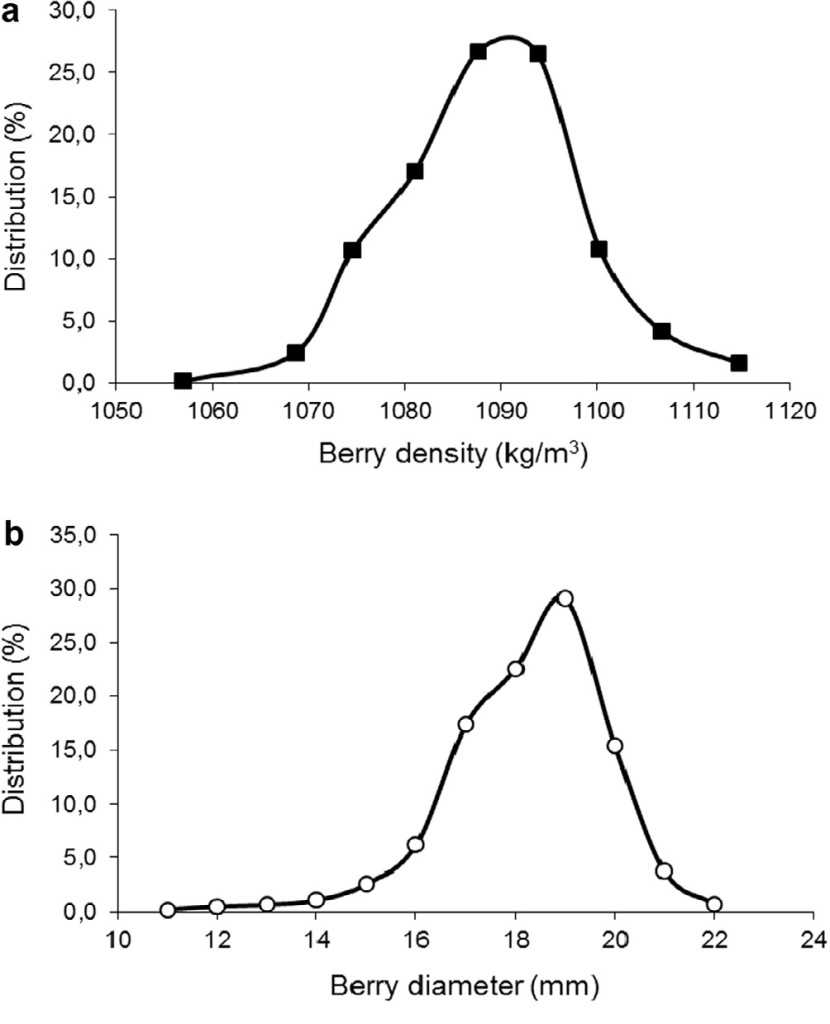
The aim of this work was to determine the impact of using independently berry density and diameter as sorting methodologies on important physicochemical parameters affecting the grape quality, such as mechanical properties, phenolic composition and aromatic profile. Muscat Hamburg berries were classified according to the density by flotation in different salt solutions and to the diameter. The three most representative density (1081, 1088 and 1094 kg/m3) and diameter (16-17, 18-19 and 20-21 mm) classes were selected. The results showed that there were relationships of both density and diameter with the mechanical properties and chemical composition of the berries. Densimetric sorting is a more promising methodology to separate grape berries with different quality attributes, particularly skin hardness, berry cohesiveness and resilience, total hydroxycinnamic acids, anthocyanins and rose oxide, than diameter sorting. This knowledge can be of great interest for the ‘fresh-cut’ industry in the production of ‘ready-to-eat’ fruits salad.
Parole chiave berry size; berry density; polyphenolics compounds; mechanical properties; table grape
codice BibTeX: clicca per mostrare
@article{
	2318_151663,
	url = {https://hdl.handle.net/2318/151663},
	author = {Rolle, Luca and Torchio, Fabrizio and Giacosa, Simone and Río Segade, Susana},
	title = {Berry density and size as factors related to the physicochemical characteristics of Muscat Hamburg table grapes (Vitis vinifera L.)},
	year = {2015},
	journal = {Food Chemistry},
	volume = {173},
	abstract = {The aim of this work was to determine the impact of using independently berry density and diameter as sorting methodologies on important physicochemical parameters affecting the grape quality, such as mechanical properties, phenolic composition and aromatic profile. Muscat Hamburg berries were classified according to the density by flotation in different salt solutions and to the diameter. The three most representative density (1081, 1088 and 1094 kg/m3) and diameter (16-17, 18-19 and 20-21 mm) classes were selected. The results showed that there were relationships of both density and diameter with the mechanical properties and chemical composition of the berries. Densimetric sorting is a more promising methodology to separate grape berries with different quality attributes, particularly skin hardness, berry cohesiveness and resilience, total hydroxycinnamic acids, anthocyanins and rose oxide, than diameter sorting. This knowledge can be of great interest for the ‘fresh-cut’ industry in the production of ‘ready-to-eat’ fruits salad.},
	keywords = {berry size; berry density; polyphenolics compounds; mechanical properties; table grape},
	doi = {10.1016/j.foodchem.2014.10.033},
	pages = {105--113}
}
Disponibilità della pubblicazione
Testo accettato per la pubblicazione
Il file è disponibile in versione accepted manuscript dall’archivio istituzionale IRIS.
Il file è soggetto a limitazioni d’uso indicate dalla licenza.
Visualizza o richiedi la pubblicazione
È possibile trovare la versione postprint dell’articolo nell’archivio istituzionale dell’Università di Torino
IRIS-AperTO record 2318/151663
Consulta la versione finale presso l’editore:
doi:10.1016/j.foodchem.2014.10.033
File non disponibile? Servono informazioni?
Puoi contattarmi e richiedere il documento attraverso il seguente modulo: