Articolo su rivista pubblicato in Journal of Agricultural and Food Chemistry, volume 61, pp. 8752–8764.
Autori: .
Abstract
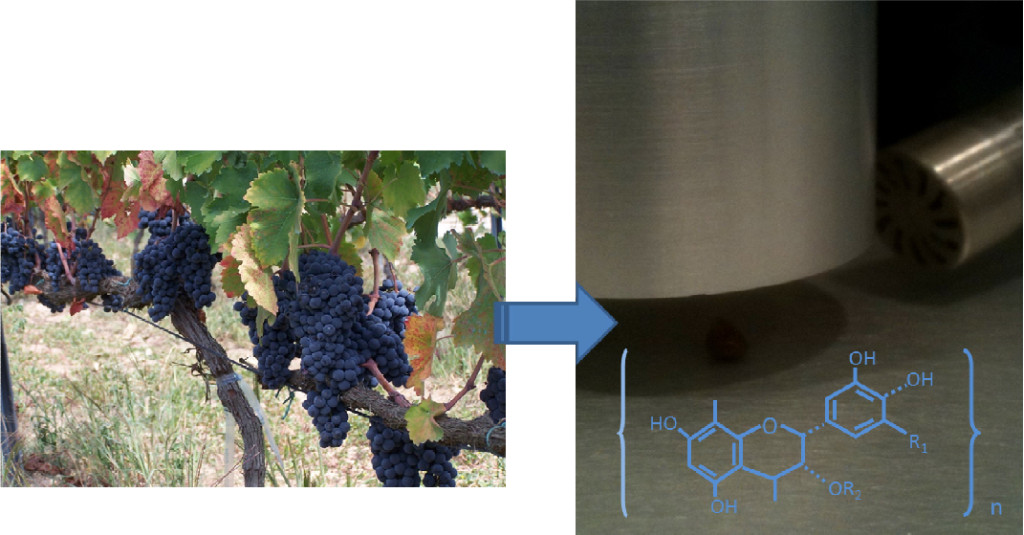
The use of instrumental acoustic parameters produced during a compression test as reliable predictors of the extractable phenolic composition in intact winegrape seeds, determined by reference chemical methods, was evaluated by means of the analytical performance of calibration models. These models were developed only for those phenolic compounds most significantly and strongly correlated with the acoustic parameters. The analytical performance of the models was expressed in terms of standard error of cross-validation (SECV) and residual predictive interquartile amplitude (RPIQ), among other statistics. Several acoustic parameters showed satisfactory predictive accuracy for the percentage of galloylation in the terminal units, the content of (-)-epicatechin and the mean degree of polymerization. Most of the reliable models developed are fairly recommended not for quantitative purposes but for fast screening (SECV%<19, 1.6<RPIQ<2.1).
Parole chiave instrumental texture analysis, acoustic parameters, seeds crunchiness, extractable phenols, LC-MS
codice BibTeX: clicca per mostrare
@article{
	2318_138502,
	url = {https://hdl.handle.net/2318/138502},
	author = {Rolle, Luca and Giacosa, Simone and Torchio, Fabrizio and Perenzoni, Daniele and Río Segade, Susana and Gerbi, Vincenzo and Mattivi, Fulvio},
	title = {Use of instrumental acoustic parameters of winegrape seeds as possible predictors of extractable phenolic compounds},
	year = {2013},
	journal = {Journal of Agricultural and Food Chemistry},
	volume = {61},
	abstract = {The use of instrumental acoustic parameters produced during a compression test as reliable predictors of the extractable phenolic composition in intact winegrape seeds, determined by reference chemical methods, was evaluated by means of the analytical performance of calibration models. These models were developed only for those phenolic compounds most significantly and strongly correlated with the acoustic parameters. The analytical performance of the models was expressed in terms of standard error of cross-validation (SECV) and residual predictive interquartile amplitude (RPIQ), among other statistics. Several acoustic parameters showed satisfactory predictive accuracy for the percentage of galloylation in the terminal units, the content of (-)-epicatechin and the mean degree of polymerization. Most of the reliable models developed are fairly recommended not for quantitative purposes but for fast screening (SECV\%<19, 1.6<RPIQ<2.1).},
	keywords = {instrumental texture analysis, acoustic parameters, seeds crunchiness, extractable phenols, LC-MS},
	doi = {10.1021/jf4024382},
	pages = {8752--8764}
}
Disponibilità della pubblicazione
Testo accettato per la pubblicazione
Il file è disponibile in versione accepted manuscript dall’archivio istituzionale IRIS.
Il file è soggetto a limitazioni d’uso indicate dalla licenza.
Visualizza o richiedi la pubblicazione
È possibile trovare la versione postprint dell’articolo nell’archivio istituzionale dell’Università di Torino
IRIS-AperTO record 2318/138502
Consulta la versione finale presso l’editore:
doi:10.1021/jf4024382
File non disponibile? Servono informazioni?
Puoi contattarmi e richiedere il documento attraverso il seguente modulo: