Articolo su rivista pubblicato in Journal of Agricultural and Food Chemistry, volume 60, pp. 9006–9016.
Autori: .
Abstract
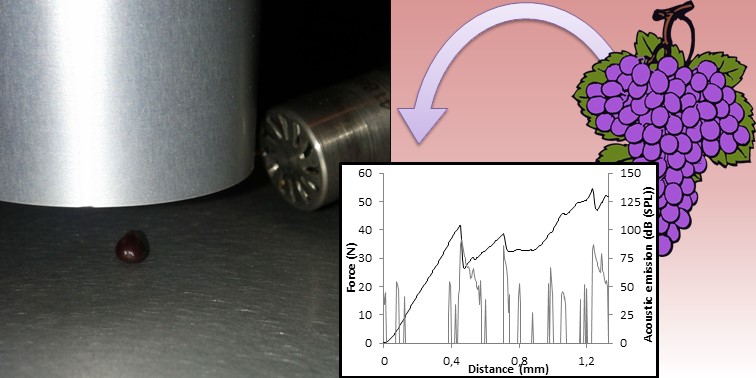
An instrumental texture analysis method has been optimized for the differentiation of grape ripening stages based on the simultaneous determination of mechanical and acoustic parameters of the seeds. Two factorial Central Composite Design was used to optimize the most influencing operative conditions (speed and deformation) on mechanical and acoustic measurements. This experimental design in combination with Response Surface Methodology showed that the most responsive parameters to changes in seeds during ripening were Young’s modulus of elasticity, many acoustic parameters measured with instrumental gain set to 0 (acoustic energy, linear distance and number of peaks) and others measured at 24 dB gain (linear distance, number of peaks and average pressure level). However, the optimal operative conditions depended on the texture parameter used. A correlation study between texture parameters and phenolic compounds of the seeds revealed that acoustic parameters like the average pressure level could be proposed as phenolic maturity indices.
Parole chiave instrumental texture analysis, acoustic emission, mechanical properties, grape seeds, phenolic maturity index, response surface methodology
codice BibTeX: clicca per mostrare
@article{
	2318_118227,
	url = {https://hdl.handle.net/2318/118227},
	author = {Torchio, Fabrizio and Giacosa, Simone and Río Segade, Susana and Mattivi, Fulvio and Gerbi, Vincenzo and Rolle, Luca},
	title = {Optimization of a method based on the simultaneous measurement of acoustic and mechanical properties of winegrape seeds for the determination of the ripening stage},
	year = {2012},
	journal = {Journal of Agricultural and Food Chemistry},
	volume = {60},
	abstract = {An instrumental texture analysis method has been optimized for the differentiation of grape ripening stages based on the simultaneous determination of mechanical and acoustic parameters of the seeds. Two factorial Central Composite Design was used to optimize the most influencing operative conditions (speed and deformation) on mechanical and acoustic measurements. This experimental design in combination with Response Surface Methodology showed that the most responsive parameters to changes in seeds during ripening were Young’s modulus of elasticity, many acoustic parameters measured with instrumental gain set to 0 (acoustic energy, linear distance and number of peaks) and others measured at 24 dB gain (linear distance, number of peaks and average pressure level). However, the optimal operative conditions depended on the texture parameter used. A correlation study between texture parameters and phenolic compounds of the seeds revealed that acoustic parameters like the average pressure level could be proposed as phenolic maturity indices.},
	keywords = {instrumental texture analysis, acoustic emission, mechanical properties, grape seeds, phenolic maturity index, response surface methodology},
	doi = {10.1021/jf302548t},
	pages = {9006--9016}
}
Disponibilità della pubblicazione
Testo accettato per la pubblicazione
Il file è disponibile in versione accepted manuscript dall’archivio istituzionale IRIS.
Il file è soggetto a limitazioni d’uso indicate dalla licenza.
Visualizza o richiedi la pubblicazione
È possibile trovare la versione postprint dell’articolo nell’archivio istituzionale dell’Università di Torino
IRIS-AperTO record 2318/118227
Consulta la versione finale presso l’editore:
doi:10.1021/jf302548t
File non disponibile? Servono informazioni?
Puoi contattarmi e richiedere il documento attraverso il seguente modulo: