Journal article published in Beverages, volume 12, pp. 13.
Authors: .
Abstract
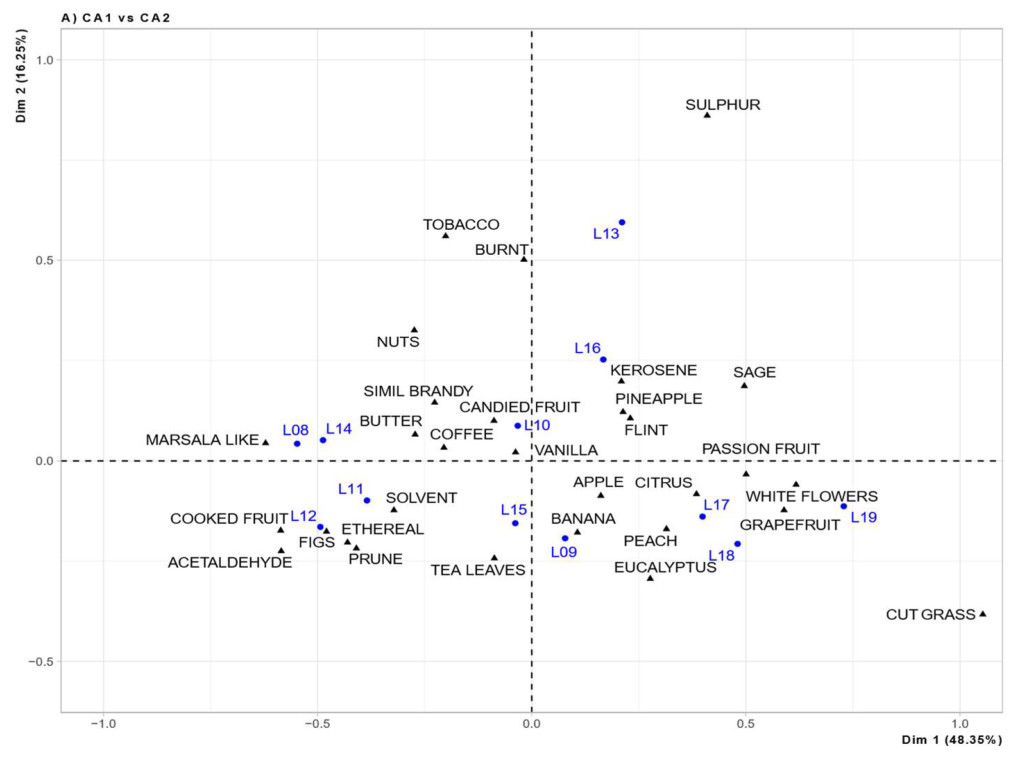
Lugana DOC is an Italian PDO white wine from the south coast of Lake Garda, produced with ‘Trebbiano di Lugana’ grapes (synonym of ‘Trebbiano di Soave’ and ‘Verdicchio bianco’) and characterised by tropical fruit, citrus, and balsamic notes due to the presence of volatile thiols and methyl salicylate, respectively. To deepen the knowledge of the aromatic profile of these wines and to study how they evolve during aging, the chemical and sensory profile of 12 Lugana DOC wines from the same winery in different consecutive vintages (2008–2019, evaluated in 2023) were analysed. Sensory analysis data were subjected to hierarchical cluster analysis, identifying four main groups that appropriately distinguished the aged wines from the young wines. Younger wines had a greenish yellow colour and were characterised mainly by fruity, citrus, floral, and flinty notes related to thiol compound contribution. Older wines, divided into three different clusters, shifted colour towards orange and were characterised by descriptors related to oxidative aging (e.g., cooked fruit, marsala-like, figs, nuts) or retained pleasant varietal and evolutionary notes (e.g., citrus, white flowers, flint, vanilla) confirmed by their chemical markers detected by GC-MS and LC-MS.
Key words Trebbiano di Lugana, volatile organic compounds, sensory analysis, aging, cluster analysis, aroma vectors
BibTeX entry: click to show
@article{
	2318_2115170,
	url = {https://hdl.handle.net/2318/2115170},
	author = {Boido, Micaela and Paissoni, Maria Alessandra and Camoni, Davide and Severi, Riccardo and Ferrari, Stefano and Cordero, Beatrice and Giacosa, Simone and Rolle, Luca and Río Segade, Susana},
	title = {Sensory-driven characterisation of the Lugana DOC white wines aging ability through odour activity value, aroma vectors, and clustering approaches},
	year = {2026},
	journal = {Beverages},
	volume = {12},
	abstract = {Lugana DOC is an Italian PDO white wine from the south coast of Lake Garda, produced with ‘Trebbiano di Lugana’ grapes (synonym of ‘Trebbiano di Soave’ and ‘Verdicchio bianco’) and characterised by tropical fruit, citrus, and balsamic notes due to the presence of volatile thiols and methyl salicylate, respectively. To deepen the knowledge of the aromatic profile of these wines and to study how they evolve during aging, the chemical and sensory profile of 12 Lugana DOC wines from the same winery in different consecutive vintages (2008–2019, evaluated in 2023) were analysed. Sensory analysis data were subjected to hierarchical cluster analysis, identifying four main groups that appropriately distinguished the aged wines from the young wines. Younger wines had a greenish yellow colour and were characterised mainly by fruity, citrus, floral, and flinty notes related to thiol compound contribution. Older wines, divided into three different clusters, shifted colour towards orange and were characterised by descriptors related to oxidative aging (e.g., cooked fruit, marsala-like, figs, nuts) or retained pleasant varietal and evolutionary notes (e.g., citrus, white flowers, flint, vanilla) confirmed by their chemical markers detected by GC-MS and LC-MS.},
	keywords = {Trebbiano di Lugana, volatile organic compounds, sensory analysis, aging, cluster analysis, aroma vectors},
	doi = {10.3390/beverages12010013},
	pages = {13},
	number = {1}
}
Publication availability
Open access
This file is available in a open access version. It is possible to download this file and distribute it observing the limitations indicated in the license.
View or request this publication
You can find the postprint version of this article in the Open Access Repository of the University of Torino:
IRIS-AperTO record 2318/2115170
View the final version at publisher:
doi:10.3390/beverages12010013
File not available? Do you need further information?
You can contact me and request this article through the following form: