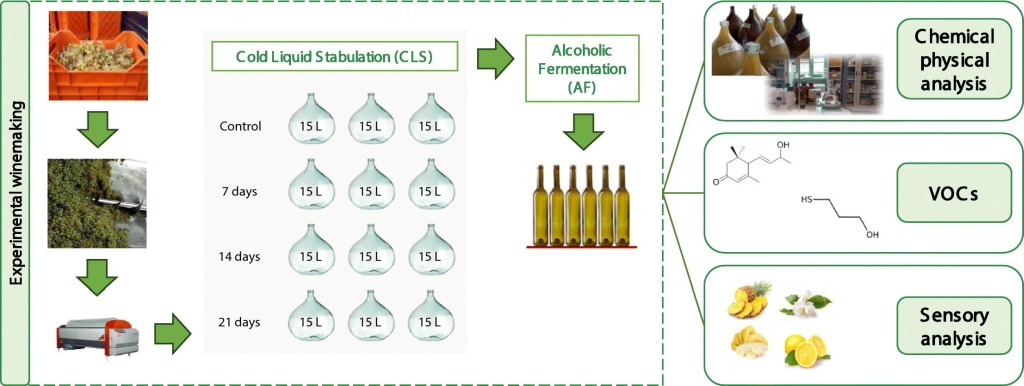
Journal article published in Food Chemistry, volume 465, pp. 142058.
Authors: .
Abstract
Cold liquid stabulation aims to extract valuable compounds from grape lees before juice clarification. In this study, 7, 14, and 21 days of lees contact were tested on aroma-neutral ‘Arneis’ and ‘Cortese’ grape juices vs control. Basic parameters, colour, polyphenols, antioxidant capacity, and volatile organic compounds were assessed throughout winemaking. Wine sensory analysis was performed. The produced wines did not differ in terms of colour and show limited differences in polyphenols, not influencing astringency and bitterness. Variety and treatment length influenced free and glycosylated volatile organic compounds. Free terpenes increased in the 21-day treated ‘Arneis’ wine (+67 %). Lower free esters in ‘Arneis’ with 14 days of stabulation were found (−10 %). On the contrary, higher values of individual esters were found in 14 and 21-day treated ‘Cortese’ wines, but these showed lower free C6 (−12 %) and sulphur compounds (−23 % and − 24 %, respectively), and higher overall wine quality with respect to non-stabulated wine.
Key words Pre-fermentative techniques, Maceration sur bourbes, Volatile organic compounds, Arneis, Cortese, Sensory analysis
BibTeX entry: click to show
@article{
	2318_2032328,
	url = {https://hdl.handle.net/2318/2032328},
	author = {De Paolis, Camilla and Zava, Andrea and Paissoni, Maria Alessandra and Río Segade, Susana and Motta, Giulia and Škrab, Domen and Beria D'Argentina, Sofia and Ferrero, Lorenzo and Giacosa, Simone and Gerbi, Vincenzo and Rolle, Luca},
	title = {Cold liquid stabulation: Impact on the phenolic, antioxidant, and aroma characteristics of wines from aroma-neutral white grape varieties},
	year = {2025},
	journal = {Food Chemistry},
	volume = {465},
	abstract = {Cold liquid stabulation aims to extract valuable compounds from grape lees before juice clarification. In this study, 7, 14, and 21 days of lees contact were tested on aroma-neutral ‘Arneis’ and ‘Cortese’ grape juices vs control. Basic parameters, colour, polyphenols, antioxidant capacity, and volatile organic compounds were assessed throughout winemaking. Wine sensory analysis was performed. The produced wines did not differ in terms of colour and show limited differences in polyphenols, not influencing astringency and bitterness. Variety and treatment length influenced free and glycosylated volatile organic compounds. Free terpenes increased in the 21-day treated ‘Arneis’ wine (+67 \%). Lower free esters in ‘Arneis’ with 14 days of stabulation were found (−10 \%). On the contrary, higher values of individual esters were found in 14 and 21-day treated ‘Cortese’ wines, but these showed lower free C6 (−12 \%) and sulphur compounds (−23 \% and − 24 \%, respectively), and higher overall wine quality with respect to non-stabulated wine.},
	keywords = {Pre-fermentative techniques, Maceration sur bourbes, Volatile organic compounds, Arneis, Cortese, Sensory analysis},
	doi = {10.1016/j.foodchem.2024.142058},
	pages = {142058},
}
Publication availability
Open access
This file is available in a open access version. It is possible to download this file and distribute it observing the limitations indicated in the license.
View or request this publication
You can find the postprint version of this article in the Open Access Repository of the University of Torino:
IRIS-AperTO record 2318/2032328
View the final version at publisher:
doi:10.1016/j.foodchem.2024.142058
File not available? Do you need further information?
You can contact me and request this article through the following form: